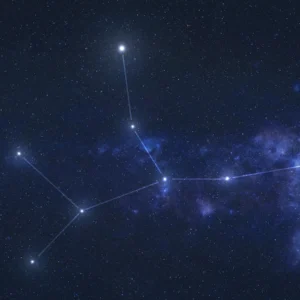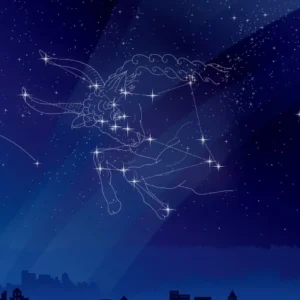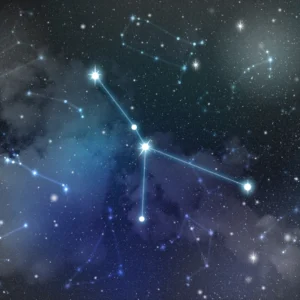




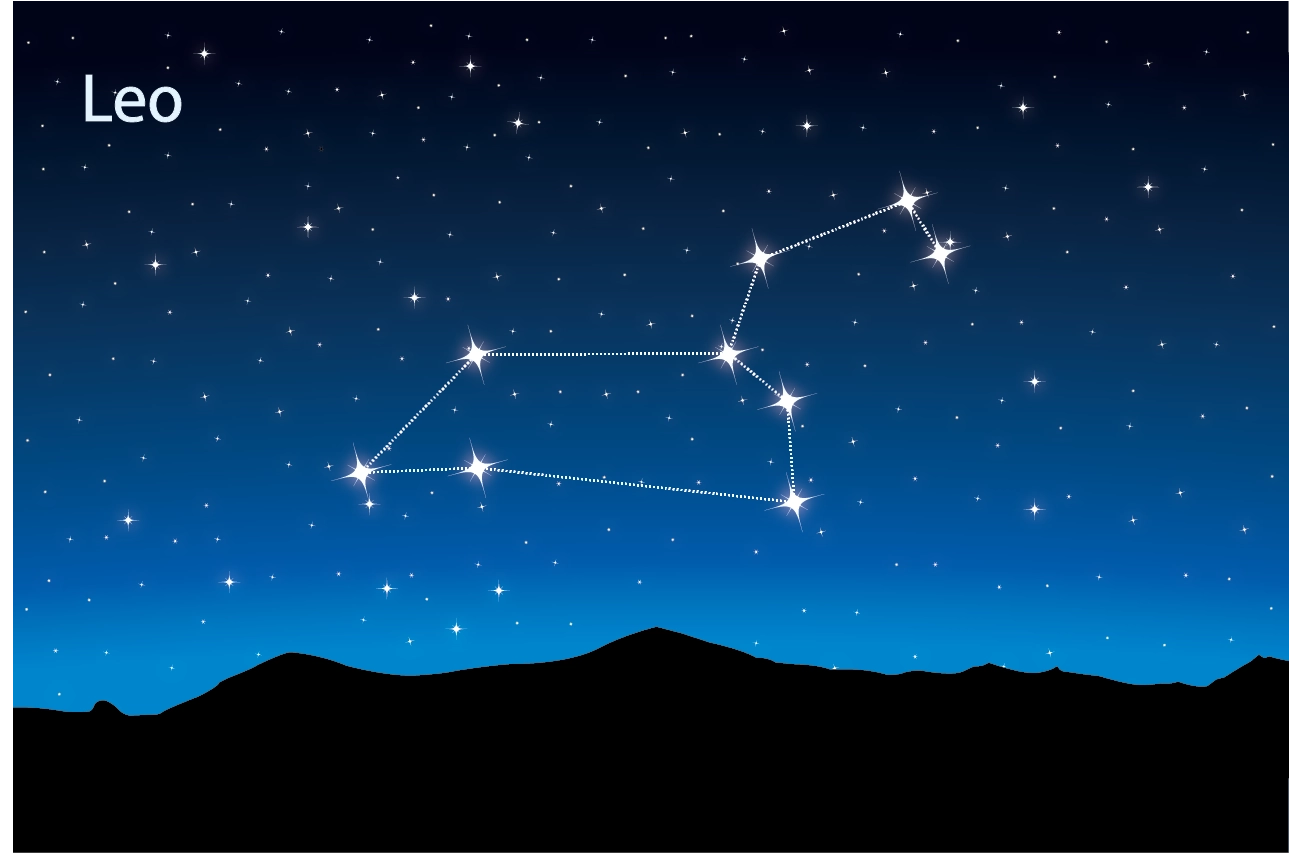
Leo is one of the most recognizable zodiac constellations in the northern sky. It sits between Cancer and Virgo, covers 947 square degrees, and is among the twelve largest constellations — so there’s plenty for your eyes to catch onto. The constellation’s shape is formed by several bright stars that create a curved pattern resembling a sickle or an upside-down question mark. This is the famous “lion’s head,” and you’ll learn to find it in just a couple of minutes.
In this guide, you’ll get a practical roadmap for spotting Leo with your own eyes, along with stories about unusual stars, distant galaxies, and meteor showers. You’ll see that Leo isn’t just “one of twelve zodiac signs” — it’s a real laboratory for exploring the Universe, from nearby dwarf stars to massive structures of deep space.
When and Where to Look for the Leo Constellation: Seasonality, Landmarks, and First Steps
The best way to start getting familiar with Leo is to understand its seasonal rhythm. Astrologers say the Sun enters Leo on July 23, but astronomically this happens closer to August 10 due to the shifting spring equinox and slow precession of Earth’s axis. For observers, this shift is actually helpful: it means Leo is still visible for a short time after sunset in summer instead of being completely lost in daylight.
The most comfortable time to see Leo at its best is from mid-winter through early spring. In February and March, Leo climbs high above the horizon around midnight, which helps reduce the effect of city lights. Under a dark rural sky, Leo’s outline becomes strikingly clear: you’ll see the “sickle” of the head and the rectangular body with the bright star Denebola marking the tail.
The easiest trick for finding Leo quickly is to use another familiar constellation as your “compass.” The best option is the Big Dipper. Suppose you draw an imaginary line through the stars Dubhe and Merak, but instead of going toward Polaris, you extend it in the opposite direction. In that case, you’ll eventually land right on Leo’s sickle. This one simple exercise instantly brings order to the sky — random stars suddenly form the shape of a lion.
How to Find the Leo Constellation Step by Step
- Go outside on a clear night away from bright streetlights and let your eyes adjust for 15–20 minutes.
- Locate the Big Dipper and the stars Dubhe and Merak — the two outer stars of the “bowl” that form a straight line.
- Draw an imaginary line from Dubhe to Merak and extend it in the direction opposite Polaris.
- Look in that area for a curved pattern of stars shaped like a sickle or question mark — this is Leo’s “head.”
- From the sickle, follow the stars toward the rectangular body and bright Denebola — that’s the full outline of Leo.
Once you go through these steps even once, Leo will stop being just a diagram from a horoscope. It becomes your constellation — one you can return to every winter and relive the moment when a familiar image suddenly appears in the real sky.
Leo’s Brightest Stars: What Regulus, Denebola, Algieba, and Others Look Like
Once you spot Leo’s outline, you’ll quickly notice that several of its stars shine much brighter than the rest. The brightest is Regulus, one of the most luminous stars in the entire night sky. It lies about 77–79 light-years away, spins rapidly, is flattened at the poles, and is part of a complex quadruple system that includes a white dwarf and possibly a brown dwarf.
Another key star is Denebola, the “lion’s tail.” Located just ~36 light-years away, it’s a white main-sequence star similar to Sirius, but without a companion. Denebola and its neighboring stars form the rectangular body of Leo, making the constellation especially easy to recognize even from a city.
Then there’s Algieba (Gamma Leonis) — not a single star but a double system of two orange giants that orbit each other roughly every 500–550 years. One of them hosts a massive planet more than 10 times the mass of Jupiter. So in Leo, we already know about real planetary systems — not just mythical lions from ancient stories.
Leo’s Brightest Stars to Watch For
| Star | Role in Leo’s Shape | Approx. Distance | Quick Description |
| Regulus (α) | Heart and “paw” near the sickle | ~77–79 ly | Rapid rotator, part of a quadruple system with a white dwarf |
| Denebola (β) | Lion’s tail | ~36 ly | Bright white main-sequence star, one of the nearest bright stars in Leo |
| Algieba (γ) | Part of the mane, knot in the sickle | ~130 ly | Double giant system, known exoplanet host |
| Zosma (δ) | Lion’s body | ~58 ly | Bright white star, key landmark when outlining the torso |
| Rasalas (μ) | Upper part of the head | ~120–125 ly | Helps complete the sickle shape, part of “Leo’s sickle” |
When you look at Leo, try to think not only about its recognizable outline but also about the actual star systems with planets, life cycles, and discoveries waiting in the future.
Exotic Stars of Leo: Carbon Giants, Variables, and Red Dwarfs
With bright stars like Regulus and Denebola stealing attention, it’s easy to forget that Leo hosts several objects astronomers speak about with special excitement. One of them is the carbon star CW Leo. About a billion years ago it exhausted its hydrogen, switched to helium burning, and now produces carbon and oxygen while expanding to enormous size — its radius is roughly three times the Earth–Sun distance.
In visible light CW Leo is faint and requires a strong telescope. But in infrared it’s one of the brightest objects in the sky: dust and gas around it emit intense heat. Soon it will shed its outer layers and become a white dwarf, leaving behind a glowing planetary nebula.
Another standout object is the variable star R Leo, a red giant that literally “breathes.” Its outer layers expand and contract, causing its brightness to swing from 11th magnitude to 4th–5th magnitude, making it visible to the naked eye. A full cycle takes about 310 days. Astronomers suspect a massive planet may orbit nearby and undergo intense evaporation due to the giant’s heat.
Leo is also home to one of the closest red dwarfs to Earth — Wolf 359, about 7.8 light-years away. It’s far too faint to see without a telescope, but it’s crucial for studying low-mass stars and magnetic activity. Wolf 359 is a flare star that occasionally brightens dramatically due to strong outbursts.
What These Exotic Stars Teach Us About the Universe:
- CW Leo shows how dying stars release carbon and heavy elements that form new stars and planets.
- R Leo helps scientists study how giant stars pulsate and how they interact with possible planetary companions.
- Wolf 359 reminds us that the most common stars in the galaxy aren’t bright giants but faint red dwarfs — many with their own planetary systems.
Leo, in this sense, is a compact “textbook” of stellar evolution: in one constellation you see young hot stars, old giants, and tiny red dwarfs that will shine for trillions of years.
Galaxies and Deep-Sky Objects in the Leo Constellation
Once you learn the star map, try looking at Leo through a telescope. This is where the story of deep space begins. Leo contains at least five Messier objects, including the famous Leo Triplet — the spiral galaxies M65, M66, and NGC 3628, about 35 million light-years away.
M66 is known as a “supernova hotspot”: several supernovae have been recorded there within a few decades, while the Milky Way hasn’t had a naked-eye supernova for over 400 years. Nearby lie M95 and M96, which likely belong to the same larger galaxy group. For amateur astronomers, this is a rare opportunity to view several galaxies within the same field of view.
Leo also contains enormous cosmic structures, such as the quasar group Huge-LQG, one of the largest known structures in the Universe — a topic that still sparks debate about the limits of cosmic uniformity. For beginners, this may sound abstract, but the key idea is simple: when you look toward Leo, you’re peering through a vast slice of cosmic history.
Deep-Sky Objects in Leo
| Object | Type | Approx. Distance | Why It Matters |
| M65 | Spiral galaxy | ~35 mln ly | Part of the Leo Triplet, easy to see through amateur telescopes |
| M66 | Spiral galaxy | ~35 mln ly | Known for multiple recent supernova events |
| NGC 3628 | Edge-on spiral galaxy | ~35 mln ly | “Hamburger galaxy” with a dark dust lane |
| M95, M96 | Spiral galaxies | ~35–38 mln ly | Likely part of the same larger group as the Triplet |
| Huge-LQG | Quasar group | Billions of light-years | One of the Universe’s largest known structures |
Deep space in Leo reminds us that even a familiar zodiac sign can actually be a doorway into massive cosmic architecture we’re only beginning to understand.
The Leonids: A Meteor Shower That Returns to Leo Every Year
If you want to see Leo turn into a real cosmic stage, watch for the Leonids meteor shower. It’s active every year from early November to early December, with a peak on November 17–18. The radiant — the point from which meteors appear to originate — lies in Leo’s sickle near Algieba.
In typical years, the Leonids produce 10–15 meteors per hour under a dark sky. But sometimes they erupt into true meteor storms. In 1833, observers in North America reported tens of thousands of meteors per hour. In 1966 and 1999, the Leonids once again turned into storm-level events.
How to Watch the Leonids in Leo:
- Choose a night near the peak (November 17–18) with minimal moonlight — a moon calendar helps.
- Drive at least 20–30 km away from city lights, lie back so you can see a large part of the sky, and make sure Leo is in view.
- Give your eyes 20–30 minutes to adjust and avoid bright phone screens — that way you’ll see far more meteors and background stars.
The physics behind the show is simple. The Leonids come from dust and debris left by the comet Tempel–Tuttle, which orbits the Sun every ~33 years. When Earth crosses a denser part of the comet’s trail, meteor rates spike. The particles enter the atmosphere at about 71 km/s, often producing bright fireballs and glowing trails that last several seconds.
From Ancient Civilizations to Exoplanets: How Our Views on Leo Have Evolved
Leo is one of the oldest constellations known to humanity. Archaeological and written evidence shows that a similar constellation was recognized in Mesopotamia around 4000 BCE. It was called UR.GU.LA — “The Great Lion,” and the star Regulus was seen as a royal symbol placed in the lion’s chest.
Later, the lion appears in Greek mythology as the Nemean Lion, the first labor of Heracles. Its hide was said to be weapon-proof, so the hero defeated it with his bare hands and later wore its skin as a cloak. According to one version, Zeus placed the lion in the sky as the constellation Leo. In Roman tradition, Leo remained a symbol of strength, royalty, and solar energy.
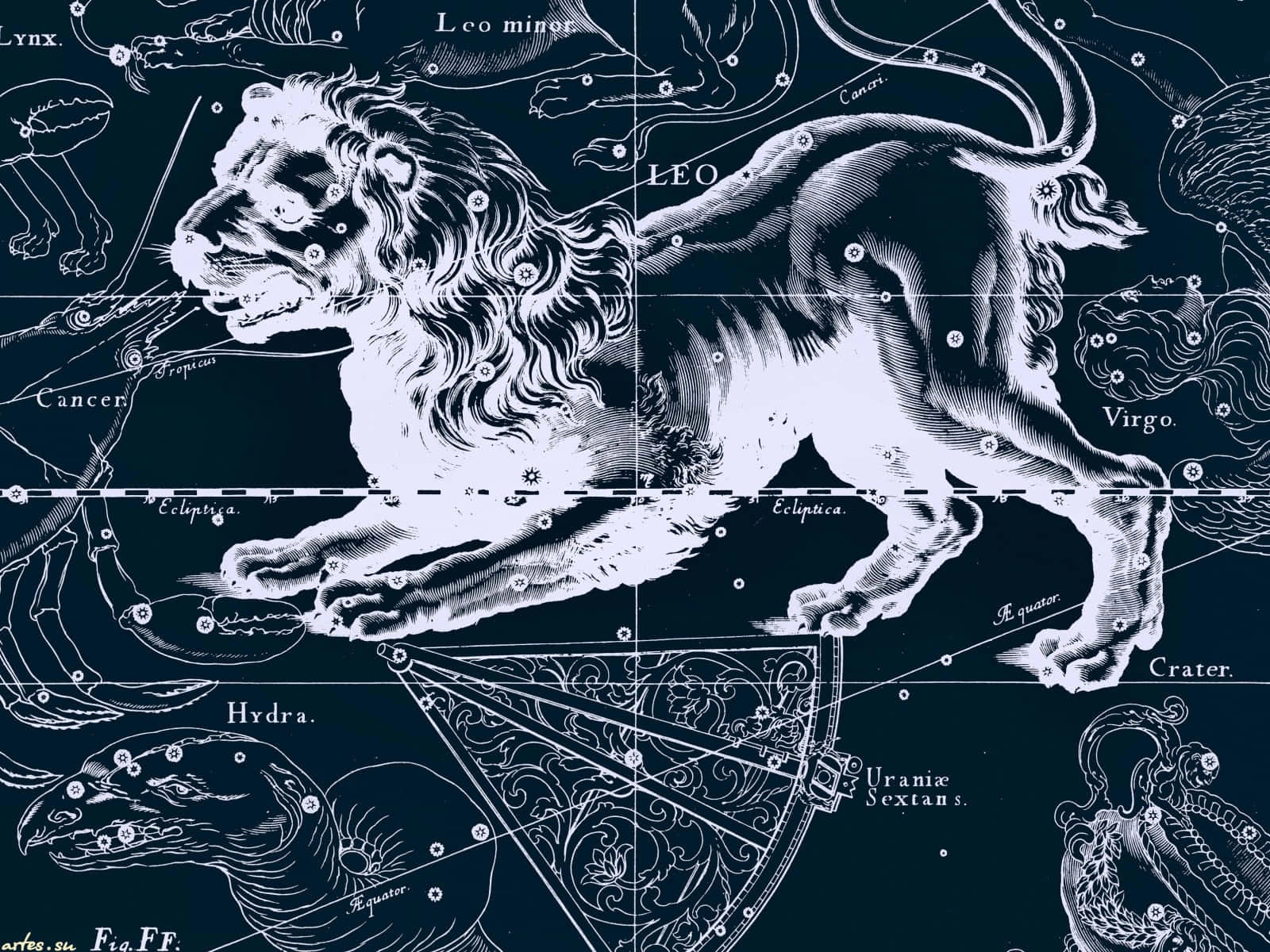
In the 3rd century BCE, part of Leo’s tail was separated into a new constellation — Coma Berenices, linked to a legend about a queen’s sacrifice. Leo was firmly established in Ptolemy’s Almagest, and by the 17th century astronomers like Tycho Brahe were already working with more modern constellation outlines.
Today, Leo interests not only historians but also exoplanet researchers. Depending on the catalog, there are dozens to more than fifty stars in Leo with known planets, and some of these systems include multiple worlds. In 2025, for example, astronomers announced a Saturn-sized planet orbiting the extremely small star TOI-6894 in Leo — a discovery that challenges theories of planet formation around low-mass red dwarfs.
Timeline of Leo Through History
| Era / Culture | Image of Leo | Key Themes |
| Mesopotamia (~4000 BCE) | UR.GU.LA — “Great Lion” | Regulus as royal star, symbol of power |
| Babylon, Persia, India | Lion, Ser, Shir, Simha | Solar and summer symbolism |
| Ancient Greece | Nemean Lion of Heracles | Myth of the unbeatable beast, heroism |
| Roman era & Ptolemy | Zodiac constellation | Fixed in the Almagest |
| Early modern era | Modern outline with sickle | Formation of today’s star maps, Coma Berenices added |
| Modern astronomy | Field of exoplanets, galaxies, quasars | Dozens of planet-hosting stars, Leo Triplet, Huge-LQG, Leonids |
Leo’s journey spans everything from sacred symbols of kingship to a “working zone” for astronomers studying exoplanets, supernovae, and the structure of the Universe.
FAQ About the Leo Constellation
Why is the Leo constellation so easy to recognize?
Because it has a very distinctive sickle or upside-down question-mark shape that forms the lion’s “head,” and it includes several bright stars like Regulus and Denebola. This combination makes Leo one of the most recognizable constellations of spring nights.
Do I need a telescope to see the Leo constellation?
No. Leo is easy to see with the naked eye under moderately dark skies. A telescope or binoculars is only needed if you want to explore galaxies, carbon stars, or faint dwarfs. For beginners, it’s enough to use the Big Dipper and Leo’s sickle as reference points.
What time of year is best for observing Leo?
The most convenient period is from late winter to late spring, when Leo rises high above the horizon. In February and March, it’s nearly overhead at midnight, so it’s less affected by city light pollution. You can see it at other times too, but not as easily.
Are there known exoplanets in Leo?
Yes. Dozens of stars in Leo are known to host exoplanets — from massive gas giants to smaller worlds. For astronomers, Leo is an important “laboratory” for testing theories of planetary formation.
Why is the Leonids meteor shower connected to Leo?
Because the radiant of the Leonids sits in Leo’s sickle, so the meteors appear to come from that area. The particles themselves come from the comet Tempel–Tuttle, which refreshes its trail every ~33 years. When Earth passes through denser debris, Leo becomes the center of a celestial show.