



The Virgo constellation is one of the largest and most prominent in the night sky, and at the same time, one of the easiest to recognize. It is home to the bright star Spica, surrounded by dozens of fainter stars, and in its depths, you can even find distant galaxies that are visible through small telescopes.
This constellation combines ancient myths, the history of sky watching, and objects that are important for modern science. It looks different from season to season and reveals new details depending on the conditions, so it never really gets boring to observe. If you want to learn how to quickly find Virgo and understand what you are looking at, this simple guide is a convenient place to start.
What the Virgo Constellation Is and Why It Is So Large
The Virgo constellation really is huge – it is the second largest constellation in the sky after Hydra. It stretches along the celestial equator between Leo and Libra and covers a big patch of sky, so it is hard to take it in with “one glance.” From the outside, it looks less like a clear drawing and more like a wide scatter of stars, where it is not easy to immediately see the figure of a woman holding a sheaf of grain. That is why beginners often get confused: it feels like there are too many stars, and it is unclear where Virgo ends and the neighboring constellations begin.
To avoid getting lost, it helps to remember a few simple reference points:
- First, Virgo is a zodiac constellation, which means the Sun, Moon, and planets pass through it.
- Second, in our era the point of the autumnal equinox is located here – the point where the Sun crosses the celestial equator in September.
- Third, familiar neighbors – Leo, Libra, and the small Corvus constellation next to Spica – help you “draw a frame” around Virgo and understand what exactly you are looking at.
Once these landmarks are clear in your mind, Virgo stops looking like a random starfield and starts to feel familiar and logical.
In Virgo you can see more than 170 stars if the sky is dark and clear. Most of them are faint and almost invisible, so your main “hint” is the bright star Spica. Its light is easy to spot even from cities, and it is Spica that lets you find the constellation in just a few minutes, even if you are observing the sky for the first time.
The Most Important Facts About the Virgo Constellation
| Fact | Explanation |
| Constellation area | 1,295 square degrees – the second largest after Hydra |
| Location | Between Leo and Libra, on the celestial equator |
| Number of visible stars | 171 stars visible to the naked eye in good conditions |
| Brightest star | Spica (Alpha Virginis), magnitude 0.92–1.04 |
| Visibility period | Best seen in March–April and early May |
These features make Virgo easy to recognize: its large size, bright Spica, and handy position on the celestial equator mean you can find it equally well from both southern and northern latitudes.
How to Find the Virgo Constellation in a Few Minutes
To find Virgo, you only need basic sky orientation skills. The easiest way is to use a chain of bright, well-known stars that form a kind of route leading straight to Spica. This method works for all observers in the Northern Hemisphere.
Step-by-step guide to finding Virgo:
- First, find the Big Dipper in the constellation Ursa Major. It is one of the most obvious patterns in the sky, so it is the best place to start.
- Imagine a line following the curve of the Dipper’s handle downwards. This line should continue the same curve, as if you are extending the handle beyond the Dipper itself.
- The first bright star along this path will be the orange star Arcturus in the constellation Boötes. You can recognize it by its warm color and very noticeable brightness.
- Continue the same imaginary arc further down. On this extension, you will see the blue-white star Spica – the brightest star in Virgo and your main reference point in this part of the sky.
- To make sure you are in the right place, look to the right of Spica and find a neat square of four stars – this is the constellation Corvus. If it fits into your field of view, you are definitely looking at Virgo.
This method works because the Big Dipper is one of the most recognizable guide patterns in the northern sky. It is clearly visible almost all year round, and its shape is so recognisable that even beginners in astronomy can easily find it in the first few minutes of observation.
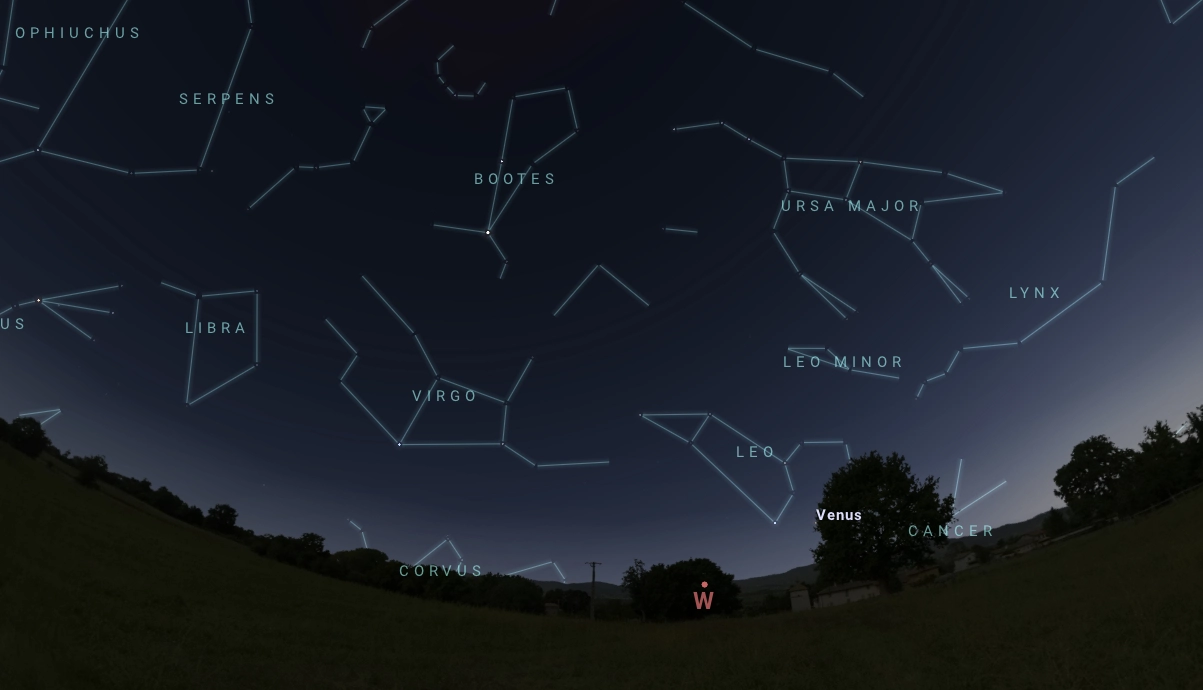
Spica is not just the main star in Virgo. Its brightness and characteristic blue-white color make it a perfect “lighthouse” that guides you to the constellation even in cities with moderate light pollution. Spica is part of the Spring Triangle asterism together with Arcturus and Denebola.
It is also useful to orient yourself using the square of Corvus – it helps you confirm that you have the right patch of sky and are indeed looking at Virgo, not at other large star groupings nearby.
When and Where You Can Best See the Virgo Constellation
The season has a big impact on how easy it is to find Virgo. Even though it is large and contains bright stars, sometimes it sits too low above the horizon or is lost in daylight. That is why it is important to know the best time to look for it.
Virgo is easiest to see from late winter to early summer, when it climbs highest in the sky around midnight. March, April, and May are especially good – during these months, Virgo is visible almost all night. This spring visibility makes it interesting for both beginners and experienced observers.
Autumn is a different story. Even though the Sun is in Virgo from September 16 to October 30, its daylight completely hides the stars. That is why autumn is the worst season for finding Virgo.
Best conditions for observing Virgo:
- Time: March – May, around the middle of the night.
- Place: areas with minimal light pollution.
- Weather: clear sky without fog or haze.
- Horizon: an open view of the southern part of the sky.
- Moon phase: ideally around the new Moon.
If you stick to these conditions, your chances rise sharply – you will see not only the outline of Virgo, but also individual objects inside it, from bright stars to faint galaxy smudges that might not appear at all under a bright or hazy sky.
Spica, Porrima, and Other Bright Stars in Virgo
You can find Virgo thanks to a single star, but it is worth looking deeper for the sake of its other unique suns. Each bright star in Virgo has its own story, physical features, and scientific value. Together, they make this constellation interesting not only to look at, but also to study as part of stellar evolution.
The Brightest Stars in Virgo
| Name | Magnitude | Description |
| Spica (Alpha Virginis) | 0.92–1.04 | Blue double system, one of the 20 brightest stars in the sky |
| Porrima (Gamma Virginis) | 2.7 | Double system with a 170-year orbital period |
| Vindemiatrix (Epsilon Virginis) | 2.8 | Yellow star leaving the Main Sequence |
| 61 Virginis | 4.7 | Yellow star with three exoplanets |
| Ross 128 | 11.1 | Red dwarf with the super-Earth Ross 128 b |
Spica is the brightest star in Virgo and the first one you should look for. It is actually made up of two hot blue stars orbiting so close to each other that we see them as a single point of light. Both stars are much more massive than the Sun and complete an orbit in just four days. Their interaction makes Spica’s brightness vary slightly, which is why it is an important target for astrophysicists studying how double star systems work.
Porrima is the second brightest star in Virgo. It is also a double star, but its components are much farther apart and move along a very elongated orbit. Because of this, the distance between them is constantly changing. In the past, they were easy to split in a small amateur telescope, but now they are so close together that you need larger optics to see the separation. Porrima is especially interesting because it lies relatively close to Earth, which makes it convenient to observe.
Vindemiatrix is a star that shows what a sun looks like when it approaches a turning point in its life. The hydrogen in its core is almost exhausted, so it is moving on to the next stage. Helium burning is starting inside, and the star itself is slowly expanding and shifting toward the red giant phase. This is one of the rare cases where the evolution of a star can be tracked in an amateur telescope, which is why Vindemiatrix is often called a “living example” of how stars grow old.
Galaxies, Quasars, and Other Distant Objects in Virgo
Most people associate Virgo with Spica, but this patch of sky hides far more than a single bright star. In this direction, you find one of the largest galaxy clusters that can be seen even with small telescopes. This region has become one of the key areas for studying the large-scale structure of the Universe.
Many galaxies in the Virgo Cluster lie at different distances from Earth, so observers see not just one group of objects but several “layers” of cosmic depth. This makes the region one of the most exciting for anyone who wants to go beyond simple star watching.
Quasars – the extremely bright cores of distant galaxies – are especially interesting here. The most famous one, 3C 273, was the first confirmed quasar powered by a supermassive black hole that amateurs could see as a faint star-like point.
Unique Deep-Sky Objects in Virgo:
- Virgo Cluster of galaxies. A region where more than 1,500 galaxies are gathered. They lie at different distances, so you can literally see the depth of space here. It is one of the richest areas of the night sky.
- M87. A giant galaxy with a massive black hole at its center. This was the black hole that was first imaged directly in 2019. M87 also launches a long jet of glowing plasma.
- M104 (“Sombrero Galaxy”). It looks like a hat because of the dark dust lane running across its middle. It is easy to recognize even in a simple telescope. M104 is considered one of the most beautiful spiral galaxies.
- Virgo Supercluster. A huge structure made up of thousands of galaxies. Our own Milky Way is part of it, too. When you look at galaxies in Virgo, you are looking toward the center of this gigantic “neighborhood.”
- Quasar 3C 273. An extremely distant and extremely bright object. Its light comes from an active black hole. Despite the enormous distance, you can still spot it as a tiny point of light in an amateur telescope.
These objects show just how vast and varied the Universe is – from nearby stars and planetary systems to galaxies and quasars billions of light-years away. That is why Virgo is one of the most valuable regions of the sky for exploring the cosmos.
Myths, Symbols, and History of the Virgo Constellation
Virgo is one of the oldest known constellations. Its image first appeared among the Babylonians, who saw it as the fertility goddess Shala. In Greek tradition, this image turned into Demeter, the goddess of agriculture, and later into Dike, the goddess of justice.
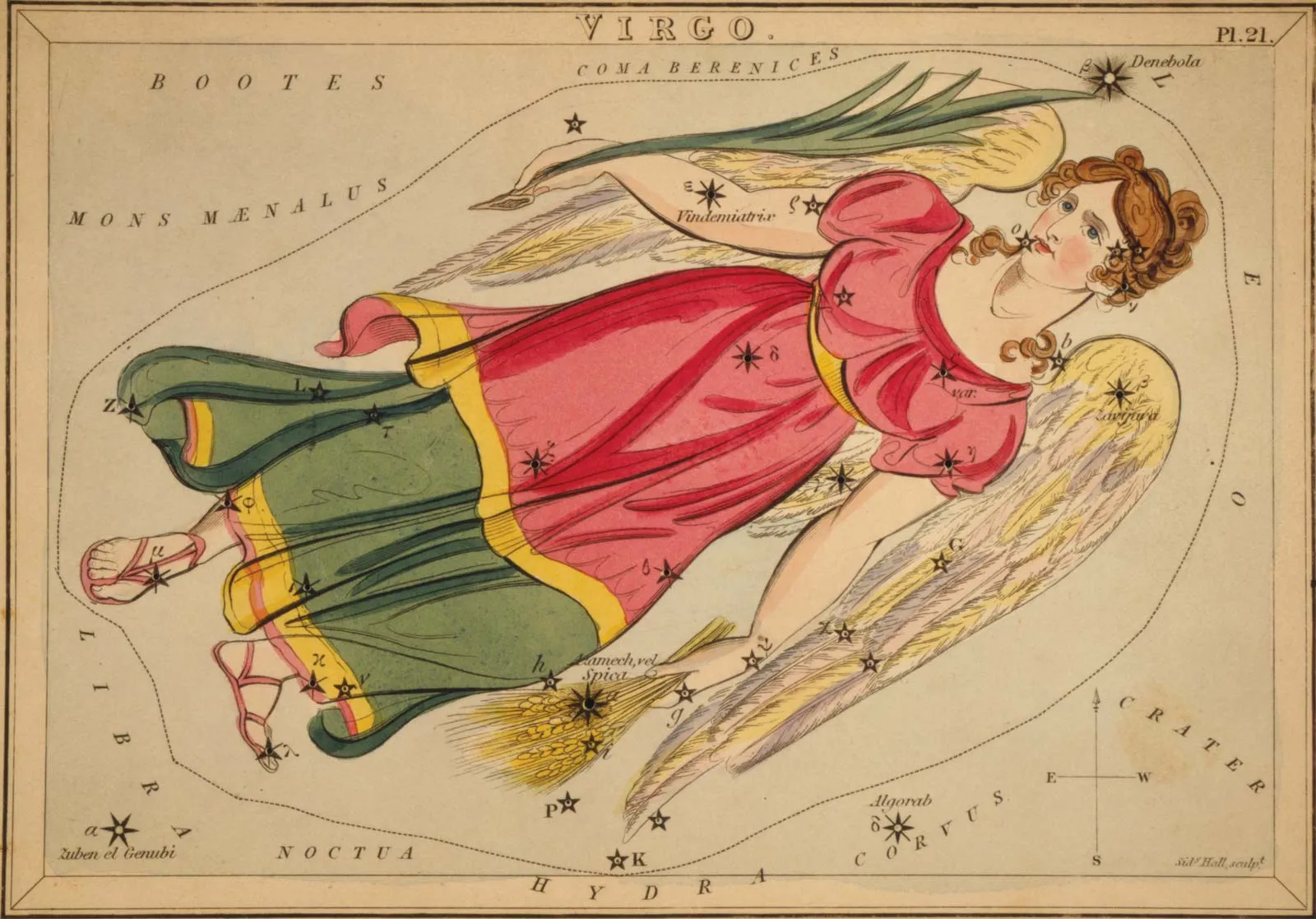
Ancient cultures saw the appearance of Virgo in the sky as a sign that harvest time was beginning. This link with fertility has survived even in the name of its brightest star, Spica, which translates as “ear of grain.” On old star maps, Spica is drawn in the hand of the woman who represents Virgo.
The Romans knew this figure as Ceres, and on many medieval maps, Virgo appears with a wing or a torch. The mythology around this constellation later became the foundation for astrological images and still remains part of the cultural history of the night sky.
Mythological Images of Virgo in Different Cultures
| Culture | Figure | Meaning |
| Babylonians | Shala | Goddess of fertility and harvest |
| Greeks | Demeter or Dike | Fertility or justice |
| Romans | Ceres | Goddess of agriculture |
| Egyptians | Woman with grain | Symbol of harvesting |
| Medieval Europe | Winged maiden | Balance between earth and sky |
These myths help explain why Virgo played such an important role for people in the past. Its appearance in the sky often coincided with key moments in the farming year, and that shaped its symbolic meaning. Today, Virgo’s mythology is still relevant – it remains part of star atlases, popular science talks, and artistic interpretations of the night sky.
When You Find Virgo, the Night Sky Feels Closer
The Virgo constellation is valuable because it helps you see the night sky differently. At first, you are just looking for the bright star Spica – and then suddenly, you notice that there is order, structure, and its own logic around it. Every star and every faint galaxy patch gives you a sense of scale and calm.
Virgo is a great place to begin: it is large, varied, and easy to recognize. Once you find it on your own at least once, the night sky stops feeling chaotic – and becomes a place you want to return to again and again.
Frequently Asked Questions About the Virgo Constellation
The simplest way is to follow an imaginary line along the handle of the Big Dipper down through Arcturus to Spica. This takes less than a minute. Once you find Spica, the outline of Virgo is easy to pick out, even in a city.
Spica is the brightest star in Virgo and one of the most noticeable stars in the spring sky. Its blue glow makes it easy to recognize. It is the main reference point that shows you where the constellation is.
The best months are March, April, and May. During this period, Virgo is visible all night and climbs highest above the horizon. In autumn, when the Sun is in Virgo, the constellation is lost in daylight and cannot be observed.
Virgo contains bright stars, exoplanets, and one of the largest galaxy clusters. In this direction lies the quasar 3C 273 – a supermassive black hole that can still be seen in amateur telescopes. The constellation shows different stages of stellar evolution and the large-scale structure of the Universe.
For the bright stars, your naked eyes are enough. A small telescope or binoculars will reveal galaxies and nebulae. A dark sky makes a big difference and helps you see even the faintest objects much more clearly.